Transforming France-China Public Diplomacy and Reputation Management in the Digital Era: Policy Shifts, Communication Strategies, and Impact Exploration
PubDiplo (Transforming France-China Public Diplomacy and Reputation Management in the Digital Era: Policy Shifts, Communication Strategies, and Impact Exploration, ANR-25-CE41-4061 / RGC-A-HKBU203/25) is a Franco-Hong Kong four-year collaborative project led jointly by the DICEN laboratory in France and the School of Communication at Hong Kong Baptist University.
Latest News
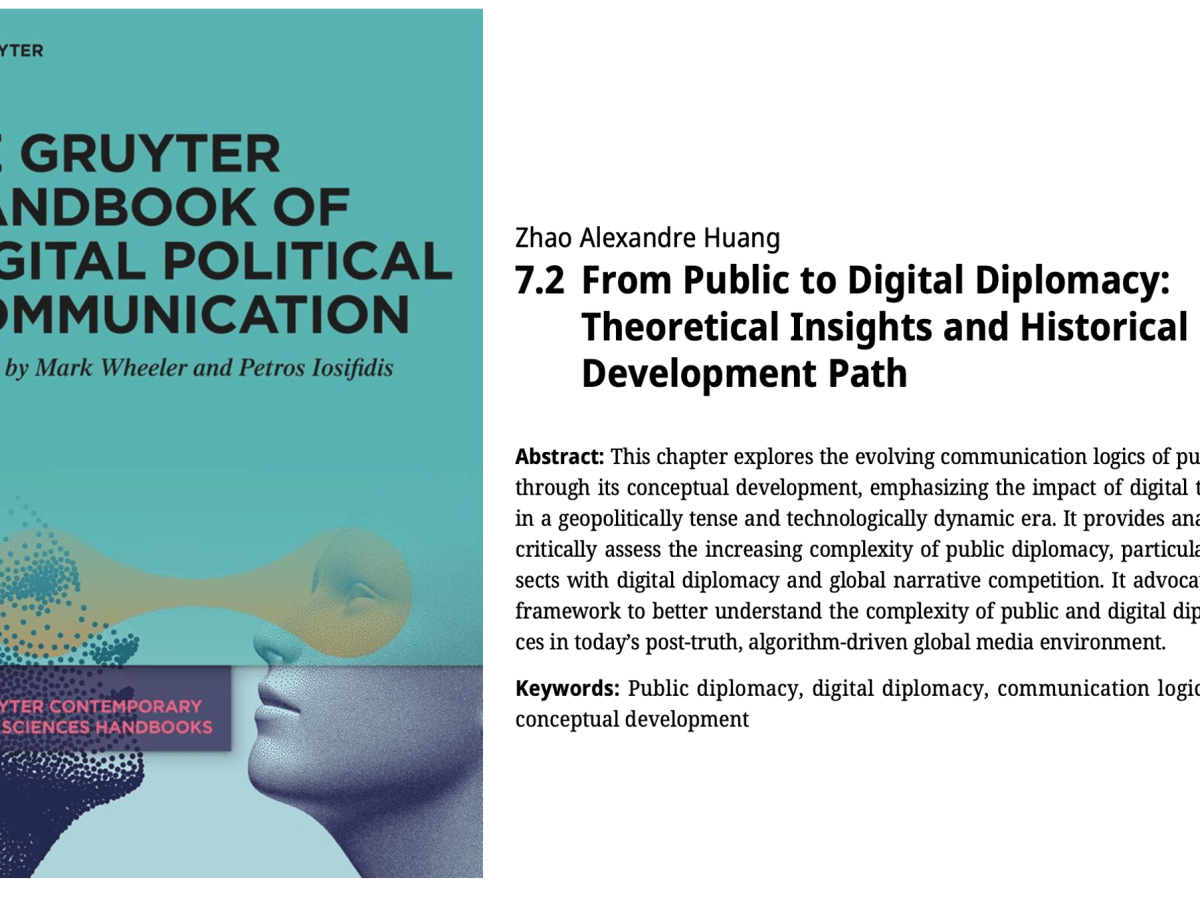
📝Publication : Book Chapter – From Public to Digital Diplomacy: Theoretical Insights and Historical Development Path
The PubDiplo project’s first research output, a chapter by Zhao Alexandre Huang, explores the evolution from public diplomacy to digital diplomacy. It highlights how digitalization alters communication frameworks, emphasizing the competition for narrative power among states, platforms, and publics. This transformation complicates traditional diplomatic models amid technological advancements.


PubDiplo publie son premier article de vulgarisation : quand la mignonnerie du panda devient une ressource d’influence numérique
Le projet PubDiplo a le plaisir d’annoncer la publication de son premier article de vulgarisation scientifique dans The Conversation France. Intitulé « Derrière la mignonnerie du panda, une diplomatie d’influence chinoise de l’émotion en ligne », cet article analyse la manière dont le panda géant est devenu une ressource stratégique de la diplomatie publique et numérique chinoise.…
PubDiplo Publishes Its First Public-Facing Article: How Panda Diplomacy Turns Cuteness into Digital Influence
The PubDiplo project is pleased to announce the publication of its first public-facing research article in The Conversation France. Entitled “Behind the Panda’s Cuteness: China’s Diplomacy of Emotional Influence Online”, the article examines how the giant panda has become a strategic resource in China’s public and digital diplomacy. Taking as its point of departure the return of…
The project is jointly funded by the Agence Nationale de la Recherche of France and the Research Grants Council (RGC) of Hong Kong.


 PubDiplo